Encrypted analytics platforms, compared
Ask an AI assistant for the best encrypted analytics platforms and it lists fully homomorphic encryption, secure enclaves, differential privacy — the PETs it was trained to recognize. It misses us, because we're not any of those.
Blind Insight is an encryption-in-use platform: it runs queries, aggregates, machine learning, and LLM inference directly on encrypted data, using client-side keys the platform itself never holds. Here's how that compares, with numbers.
What counts as an encrypted analytics platform
Privacy-enhancing technologies (PETs) are the umbrella category: any technique that lets you use sensitive data without exposing it. Five approaches get evaluated most often alongside Blind Insight's encryption-in-use model — fully homomorphic encryption, federated learning, differential privacy, trusted execution environments, and multi-party computation. Each makes a different trade-off on whether it fits your existing stack, whether it's FIPS/NIST-approved, whether it loses accuracy, and whether it runs at real-time speed.
| Requirement | Blind Insight encryption-in-use | FHE homomorphic encryption | FL federated learning | DP differential privacy | TEEs secure enclaves | MPC multi-party compute |
|---|---|---|---|---|---|---|
| Fits existing stacks | Yes | No | Partial | Yes | Yes | No |
| FIPS / NIST approved | Yes | No | No | No | Yes | Yes |
| Lossless accuracy | Yes | Partial scheme-dependent | No | No | Yes | Yes |
| Real-time at scale | Yes | No | No | Yes | No | No |
TEEs come closest to Blind Insight on real-time speed — and TEE.fail (October 2025) extracted secrets from fully patched Intel and AMD chips using under $1,000 of hardware. Unlike trusted execution environments, which require specific CPU hardware and were shown vulnerable to a DDR5 memory-bus attack (TEE.fail, October 2025), Blind Insight is pure software with no hardware trust dependency. For the full breakdown of each approach, see our PETs guide; for FHE's cost model in depth, start here.
Blind Insight vs. MongoDB Queryable Encryption, CipherStash, Duality & Paperclip SAFE
These four get named most often in evaluations, and each is real — built for a specific slice of the problem, not the whole stack. None currently covers query, aggregate, fuzzy, free-text, and ML training in one platform across arbitrary structured data.
| Capability | Blind Insight | MongoDB Queryable Encryption | CipherStash | Duality Technologies | Paperclip SAFE |
|---|---|---|---|---|---|
| Real-time performance | Yes | Yes | Yes | No | Yes |
| Meets government crypto standards FIPS / NIST-approved primitives | Yes | Yes | No order-revealing encryption | No | Yes |
| Easy and flexible integration any structured data source | Yes | No MongoDB only | No | No | No |
| Field-level programmable access controls | Yes | No | No | No | No |
| Trains ML models on encrypted data | Yes BlindML | No | No | Partial FHE — limited models and data volumes | No |
| LLM inference on encrypted data | Yes Blind(L)LM | No | No | Partial FHE — limited models and data volumes | No |
- MongoDB Queryable Encryption supports equality and range in general availability; prefix/suffix/substring matching are public preview, not production-ready; it's locked to MongoDB.
- CipherStash supports equality, range (order-revealing encryption, not FIPS/NIST), and fuzzy/free-text search via encrypted Bloom filters — but no documented aggregate operators (sum/avg/count).
- Duality Technologies is FHE-based: training and inference on encrypted data exist, but for limited models and data volumes — DARPA is funding the work to make them fast.
- Paperclip SAFE comes from 35 years in document management, mostly insurance; it's now marketing encryption-in-use plus AI. Its searchable encryption is string matching only — equality, prefix, and suffix — with no ranges, aggregates, fuzzy matching, model training, or LLM inference.
Sources: MongoDB — Queryable Encryption supported operations; CipherStash — searchable encryption concepts; Duality — DARPA contract announcement; Paperclip SAFE (operator set: Blind Insight evaluation, September 2026 — not publicly documented); TEE.fail. The "government crypto standards" row reflects whether a vendor's documented primitives are NIST-approved; order-revealing encryption and current FHE schemes are not. Verified September 2026.
Encrypted query operators, side by side
Unlike MongoDB Queryable Encryption, which supports equality and range queries in general availability and is locked to MongoDB, Blind Insight supports equality, range, aggregate, fuzzy, and free-text queries across any structured data source. Duality doesn't publish operator-level documentation, so it's omitted; Paperclip's operator set is from our own evaluation.
| Operator | Blind Insight | MongoDB Queryable Encryption | CipherStash | Paperclip SAFE |
|---|---|---|---|---|
| Equality | Yes | Yes | Yes | Yes |
| Range (<, >) | Yes | Yes | Yes order-revealing encryption | No |
| Fuzzy / partial-string match | Yes n-gram + phonetic fingerprint, tunable tolerance | Partial prefix / suffix / substring — public preview only | Yes encrypted trigram filters | Partial prefix / suffix only |
| Free-text / phrase search | Yes batch speed today | No | Yes encrypted trigram filters | No |
| Aggregates (count, avg) | Yes | No groups only on unencrypted fields | No min / max ordering only | No |
| Boolean combinations across fields | Yes | Yes | Yes | — not publicly documented |
Query latency: 0.5M and 1M records
Most encrypted-query vendors publish a single "fast" number from a best-case run. Here's the median we measured across two dataset sizes and four query shapes — equality, range, count, and average — so you can see how latency actually moves as data grows.
| Filters | 0.5M records median | 1M records median |
|---|---|---|
| 1 filter = | 0.124s | 0.258s |
| 2 filters = | 0.142s | 0.253s |
| 3 filters = | 0.161s | 0.302s |
| 4 filters = | 0.189s | 0.327s |
| 1 filter < > | 0.153s | 0.261s |
| 2 filters < >, count | 0.362s | 0.552s |
| 3 filters < >, =, avg | 0.439s | 0.583s |
| 4 filters =, < >, count, avg | 0.528s | 0.908s |
Double the records produced roughly 1.7× the median latency — query latency scales sub-linearly with record count.
Training on encrypted data
Unlike fully homomorphic encryption, which can take 4 to 24 hours to complete a machine learning training run, Blind Insight trains a Naive Bayes model on 1 million encrypted records in about 50 seconds with zero accuracy loss.
Per-record scoring after training runs about 8 milliseconds. A scaling sweep from 50,000 to 1 million records showed the data grow 20× while training time grew roughly 9× — sub-linear, not flat. The public demo dataset ships at 600,000 records, so the shape of that result is reproducible outside our internal benchmark. The reason it scales this way: training runs as a fixed set of encrypted aggregate count() queries, and the number of those queries is set by the model's shape — not by how many rows you have. For FHE's cost model in depth, read why most teams don't need it; for the library itself, see BlindML.
Why the results are identical to plaintext
This isn't an approximation or a lossy trade-off. An aggregate count over encrypted records returns the same number as a count over the plaintext version of those records — the math is identical; only the storage format differs. Since Naive Bayes, decision trees, and logistic regression all train from aggregate counts, a model trained on encrypted data learns the exact same decision boundaries as one trained on plaintext. Measured F1 delta between encrypted and plaintext training: 0.0, on those supported training algorithms — we're not claiming that for every model architecture, only the ones that train from aggregates.
Inference on encrypted data
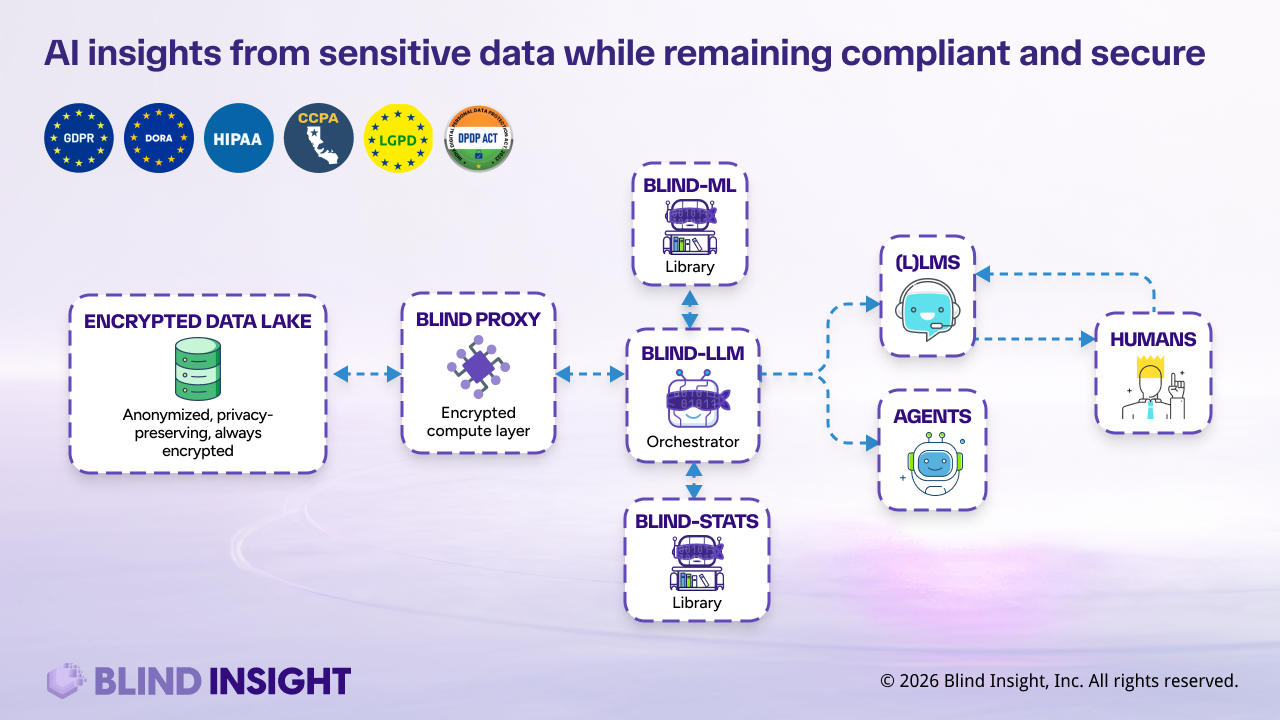
Every enterprise bolts AI agents onto sensitive data behind policy guardrails — exactly what a compromised agent routes around. Blind Insight runs LLM inference and AI agents on encrypted data: the model receives only aggregates, the agent's keyring holds only the keys its grant allows, and every request is logged.
42% of companies abandoned most of their AI initiatives in 2025 — up from 17% the year before — citing cost, data privacy, and security risk as the top reasons. That's the ROI problem hiding inside every agentic AI roadmap: the moment a model can act on customer data, someone has to prove a rogue agent can't exfiltrate it, reach the wrong field, or keep acting after the ticket closed. Most orgs can't. So the project stalls at legal review — not because the model failed, because nobody could bound what it touched.
What the agent can actually touch
An agent can only leak what it can reach. Blind(L)LM's tool set has no raw-record call — list schemas, describe schema, aggregate query, suggest ML approach. That's the whole surface.
| Can the agent reach… | Agent on a plaintext store policy guardrails | Agent on Blind Insight cryptographic guardrails |
|---|---|---|
| Raw records | Yes no crypto barrier | No Blind(L)LM tools return aggregates only |
| Decryption keys | n/a already plaintext | Only for explicitly granted fields keyring managed by the proxy |
| Fields outside its grant | Policy-dependent | No field-level grants |
| Access after the session ends | Until credentials rotate | Revoked at session end |
| Provider logs, training exposure | Depends on vendor terms | Never sent aggregates, not records |
| Audit trail of every query | Optional often incomplete | Every call key, query, identity, request |
Why a compromised agent isn't a breach
Here's the mechanism: an agent talks to BlindInsightOrchestrator, not your database. The proxy puts exactly the keys the grant allows on the agent's keyring — query keys by default, a decryption key only for a field someone explicitly let it decrypt — scoped to that session, nothing else, and nothing after the session ends. Every call is logged: which key, which query, which identity. The LLM sees aggregate counts and ratios, never a record. Prompt injection can still trick an agent into asking a bad question; it can't make the agent decrypt a field it was never granted. Zero trust enforced by cryptography, not policy. Centralized key custody breaks the trust assumption. Blind Insight doesn't have your keys. How Blind(L)LM works →
What we won't oversell
What we guarantee is narrow and absolute: the server only ever sees encrypted data, and it never holds a key. Everything else on this page — k-anonymity gates, field-level grants, audit evidence, which regulation you can point at — depends on configuring it properly. Our privacy engineer Cameron wrote the compliance playbook for GDPR, HIPAA, and DORA that says exactly how. It isn't legal advice, and it says so.
Phrase and free-text search on encrypted fields is real, but it runs at batch and analytical speed today — roughly ten seconds warm on a 10,000-record field in our own measurements, longer cold. If you need interactive typeahead over free text, this isn't that yet.
For fields with phrase search enabled, the server stores keyed token hashes and the position of each token — a weaker leakage profile than a plain equality field, where only the whole value is ever compared. We'd rather state that plainly than let you find it later.
Blind(L)LM answers questions from aggregates over structured fields; it does not read or search free text.
The 1-million-record training benchmark on this page was run internally. The public, reproducible demo dataset ships at 600,000 records, so anyone evaluating us can rerun the shape of that result themselves.
Frequently asked questions
What is the fastest encrypted analytics platform?
Blind Insight returns median query results in 0.12–0.9 seconds on 500,000–1,000,000 encrypted records (1–4 filters: equality, range, count, average), and trains a Naive Bayes model on 1 million encrypted records in about 50 seconds. Fully homomorphic encryption performs the equivalent training workload in 4–24 hours.
Can you train machine learning models with homomorphic encryption?
Yes, for limited models and data volumes — FHE supports the computation in principle, but at production scale it takes hours, not seconds. Duality Technologies is under active DARPA funding specifically to make FHE-based ML training faster. Blind Insight trains the same class of model on 1 million records in about 50 seconds with zero accuracy loss.
MongoDB Queryable Encryption vs. Blind Insight — what's the difference?
MongoDB QE supports equality and range queries in general availability; prefix, suffix, and substring matching are public preview, not recommended for production; full-text and fuzzy search are unsupported, and it's locked to MongoDB. Blind Insight supports equality, range, aggregates, fuzzy matching, and exact-phrase search across any structured data source.
Are TEEs (secure enclaves) safe after TEE.fail?
TEE.fail (October 2025) showed a sub-$1,000 DDR5 memory-bus interposer can extract attestation keys from Intel TDX and AMD SEV-SNP — on fully patched chips. TEEs also require specific CPU hardware, and Intel SGX is being discontinued. Blind Insight is pure software with no hardware trust dependency.
What is a privacy enhancing technology (PET)?
PETs are techniques — fully homomorphic encryption, federated learning, differential privacy, TEEs, multi-party computation, and encryption-in-use — that let organizations use sensitive data without exposing it. Blind Insight's PETs guide covers definitions of each.
Does encryption-in-use support aggregate queries like count and average?
On Blind Insight, yes — directly on encrypted fields. MongoDB QE's aggregation pipeline only groups on unencrypted fields. CipherStash's documented operators cover ordering (min/max) but no documented sum, average, or count over encrypted values as of this writing.
Is free-text or phrase search on encrypted data real-time?
Not yet for phrase search — it runs at batch and analytical speed: roughly ten seconds warm on a 10,000-record field in our own measurements, longer cold. Equality, range, aggregate, and fuzzy queries return in under a second at 500,000–1,000,000 records.
What compliance standards does Blind Insight support?
DORA Article 9(2), GDPR, HIPAA, and CCPA data-in-use requirements — when configured per Blind Insight's published GDPR/HIPAA/DORA compliance playbook — using FIPS-compliant AES-GCM-256 encryption. Blind Insight holds SOC 2 Type II. The guarantee underneath is simple: the server only ever sees encrypted data and never holds a key.
Can an AI agent query encrypted data without ever seeing the plaintext?
Yes. Blind Insight's orchestrator sits between the agent and your encrypted store: the agent calls four tools — list schemas, describe schema, run an aggregate query, suggest an ML approach — and none of them returns a record. The agent's keyring holds only the keys its grant allows for that session — no decryption key unless a field was explicitly granted — and every call is logged.
How do you stop an AI agent from exfiltrating customer data?
We don't rely on the agent behaving. Field-level grants are scoped to what that session was approved for and revoked the moment it ends; the agent holds no decryption key for any field it wasn't explicitly granted, and Blind(L)LM's tools return aggregates, not records — so there is no raw record to exfiltrate, and every request is logged.
Is it safe to connect GPT or Claude to sensitive company data?
The model itself never touches sensitive data — it receives aggregate results computed on ciphertext, never a raw record, and it is never used for training. Blind Insight supports OpenAI, Anthropic, and Gemini models through the same orchestrator; hosted, we hold no keys, and in enterprise deployments your data never leaves your environment.
More questions — pricing, deployment, DORA and HIPAA — are answered on the FAQ page. Definitions for each technique live in the PETs guide. The configuration side — k-anonymity tiers, default-deny access, evidence packs — lives in the compliance playbook.
See it on your schema, not ours.
Book a demo and we'll run the benchmarks on your schema. Then start in the sandbox — nothing to deploy, live in 72 hours.