DORA Encryption-in-Use: The Fallback Isn't Free
DORA Art. 9(2) covers data in use. The RTS fallback applies only where encryption-in-use isn't possible — it is now. The fallback compounds compliance debt.

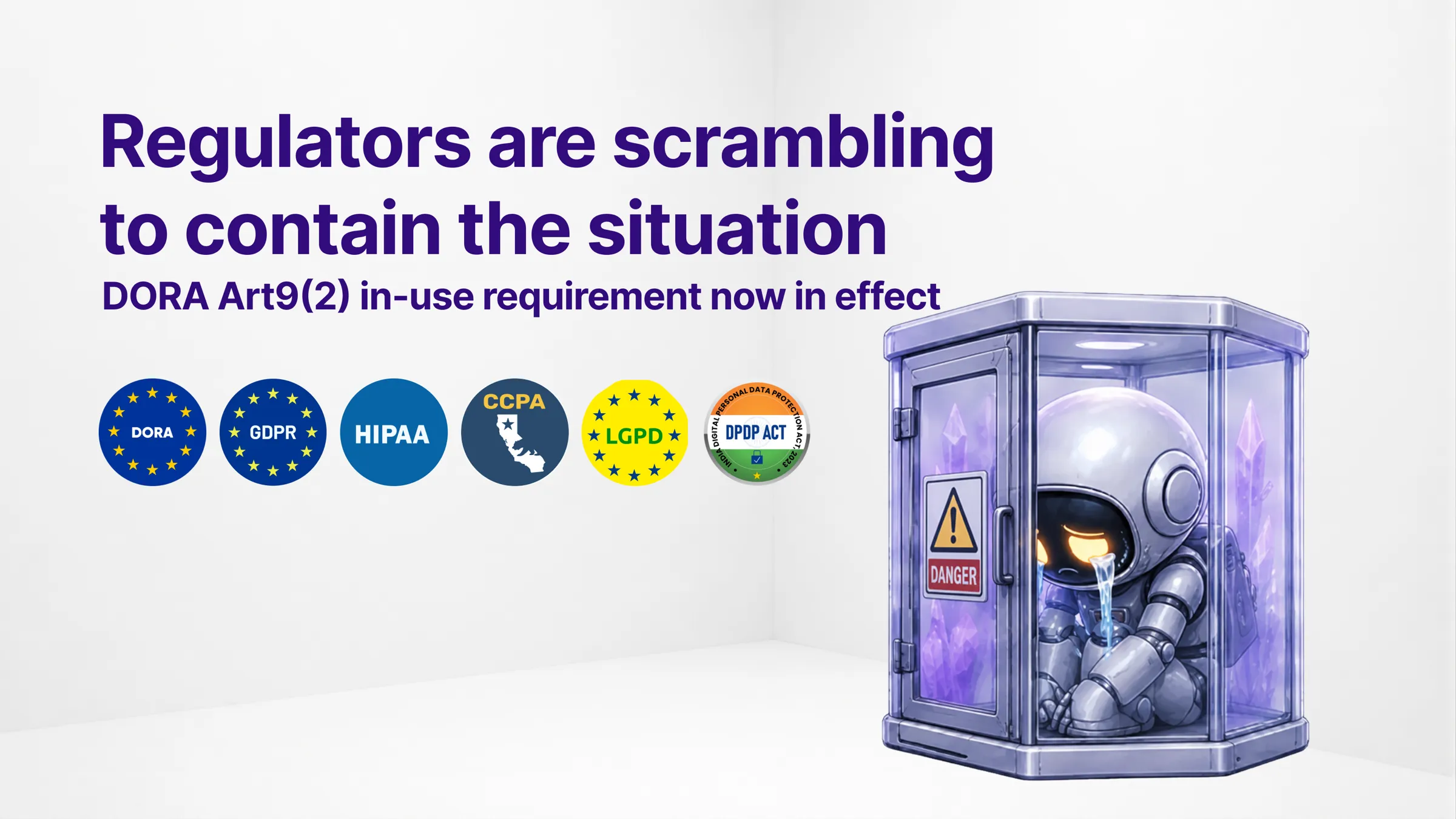
Data used to be called the new oil. Lately it’s feeling more like uranium — extraordinarily valuable, and just as dangerous in the wrong hands.
That tension is a big part of why 42% of companies abandoned most of their AI initiatives in 2025, up from 17% the year before, according to S&P Global Market Intelligence. Ask why, and the easy answer is the model: too slow, too expensive, the ROI never showed up. The easy answer is wrong.
The problem isn’t the models. It’s not budget, compute, or capability. The most valuable data an enterprise owns — transaction histories, identity records, patient charts — is also the data nobody is cleared to touch. A model can’t train, an agent can’t infer, and a dashboard can’t generate insight from data it isn’t allowed to see.
That’s not a new problem. It’s an old one, compounding fast: AI-powered attacks are rising, agents are breaking out of their own sandboxes, and the people who built the black box can’t always say what’s happening inside it. Regulators are the ones now scrambling to draw a boundary around it. In January 2025, DORA became the first major regulation to say, in writing, that data has to be protected not just at rest and in transit, but in use.
Two terms this piece leans on. Encryption-in-use means computing on data — searching it, aggregating it, training on it — while it stays encrypted, so the application layer never holds plaintext. Compliance debt is what accumulates when you satisfy today’s regulatory requirement with ever more compensating controls instead of fixing the architecture underneath.
DORA changed the encryption conversation
Financial institutions have spent years protecting data at rest and in transit. But what happens when that data is actively being processed?
That’s where encryption-in-use enters — and where DORA drew a line most institutions haven’t crossed yet.
DORA Article 9 requires financial entities to maintain high standards of confidentiality, integrity and availability for data “at rest, in use or in transit.”
Article 6 of Commission Delegated Regulation (EU) 2024/1774 — the RTS on the ICT risk-management framework — requires financial entities to establish an encryption and cryptographic-controls policy covering data at rest, data in transit, and data in use where necessary. (EUR-Lex)
| Date | Milestone | Status |
|---|---|---|
| 16 Jan 2023 | DORA entered into force | Past |
| 17 Jan 2025 | DORA became fully applicable | Past |
| 30 Apr 2025 | First major Registers of Information submission to the ESAs | Past |
| July 2025 | ESAs notified ICT providers assessed as potentially critical | Past |
| 18 Nov 2025 | First Critical ICT Third-Party Providers (CTPPs) formally designated | Past |
| 2026 | Ongoing supervisory oversight of CTPPs begins and ramps up | Current |
| 2026 onward | Financial entities begin or continue DORA TLPT (threat-led penetration testing) cycles | Current |
| 2026 onward | Annual, updating Register of Information reporting | Recurring |
| 2026 onward | Ongoing DORA incident reporting, testing, ICT-risk management and third-party oversight | Recurring |
| 2028 onward | First full three-year TLPT cycle comes due for entities subject to the three-year requirement | Upcoming |
DORA isn’t only about encrypting databases and network traffic. Data matters just as much while it’s being used as while it’s sitting still or moving.
The problem: encryption-in-use has historically been hard
Protecting data at rest and in transit is relatively straightforward: encrypt the storage and encrypt the connections moving data between systems.
Data in use is different.
Applications traditionally need access to usable data to search, analyze, or process it, creating a fundamental challenge: how do you compute on data without exposing the data itself?
Historically, organizations have written off encryption-in-use as too expensive to run, too complex to integrate, and too hard to retrofit into legacy systems without specialized cryptographic expertise — chief among them fully homomorphic encryption, which most teams don’t actually need.
The result? Many organizations have reasonably concluded that encryption-in-use is too costly or impractical and instead rely on the alternative controls DORA permits.
But “permitted” doesn’t mean “best.” Regulatory expectations keep tightening, and compensating controls that pass today’s audit aren’t guaranteed to pass the next one.
DORA anticipated this problem
The regulation acknowledges the complexity of encrypting data in use and says that where it is not feasible or is too complex, financial entities can protect confidentiality, integrity and availability through other ICT security measures.
Then Article 6 of the RTS makes the alternative explicit:
Where encryption of data in use is not possible, financial entities shall process data in use in a separated and protected environment, or take equivalent measures to ensure the confidentiality, integrity, authenticity, and availability of data.
This is a crucial distinction, and a narrower one than it first reads: the alternative exists for the case where encryption-in-use isn’t possible. It is not a standing choice between two equal options.
The compliance trap: “If the alternative is allowed, why change?”
So, if DORA permits alternative controls, why would a financial institution invest in encryption-in-use?
Start with the word the fallback hangs on. The RTS doesn’t offer segregation as an equal option; it offers it where encryption of data in use is not possible. That is a conditional, and the condition is doing all the work. When the RTS was drafted, encrypting data in use at production speed was a research topic — fully homomorphic encryption took hours to do what a warehouse does in seconds. It isn’t a research topic anymore. Blind Insight trains a model on a million encrypted records in about 50 seconds and runs aggregates, fuzzy match, and free-text search on ciphertext inside the warehouse you already have. Once encryption in use is possible for a workload, “not possible” stops being something you can write in the audit file for that workload.

The fallback, drawn to scale: a protected processing environment keeps the data safe by keeping it out of reach — including from the models and analysts who need it.
Two things follow. First, the burden sits with the entity. It is the financial institution, not the supervisor, that has to be able to justify why encryption in use was not possible for a given system, and that justification gets harder every year the technology is commercially available. Second, guidance follows capability. The RTS already tells entities to stay abreast of developments in cryptography and adapt; when a control moves from impossible to ordinary, regulators tend to stop describing it as optional. A control environment built on the fallback today is built on a clause written for a world that has since changed.
Compliance isn’t the same thing as maximum protection
An organization can satisfy a regulatory requirement with compensating controls and still fall short of the strongest security architecture available.
DORA itself requires organizations to consider leading practices and standards and to adopt mitigation and monitoring measures where they cannot use the most reliable techniques.
The regulatory direction is toward stronger protection
Regulatory frameworks keep moving toward stronger protection of data across its lifecycle. The question isn’t whether a control is compliant today — it’s whether the architecture behind it still holds up in three years.
Compensating controls have a cost too
Organizations often think: encryption-in-use = expensive.
But the real comparison is:
Encryption-in-use investment
vs.
Segmentation + isolation + access controls + monitoring + DLP + privileged access + audit evidence + ongoing compliance work + future remediation
In other words: the fallback isn’t free.
The hidden cost of the “fallback”
Today
Organizations may need to maintain:
- Protected processing environments
- Additional infrastructure
- Network segmentation
- Access controls
- Monitoring
- Logging
- Privileged-access controls
- DLP
- Compensating controls
- Risk assessments
- Documentation
- Audit evidence
Tomorrow
Every time regulatory expectations change, the organization has to revisit that entire control environment.
This creates compliance debt
Like technical debt, compliance debt accumulates when organizations solve today’s regulatory requirement with increasingly complex compensating controls rather than addressing the underlying architectural challenge.
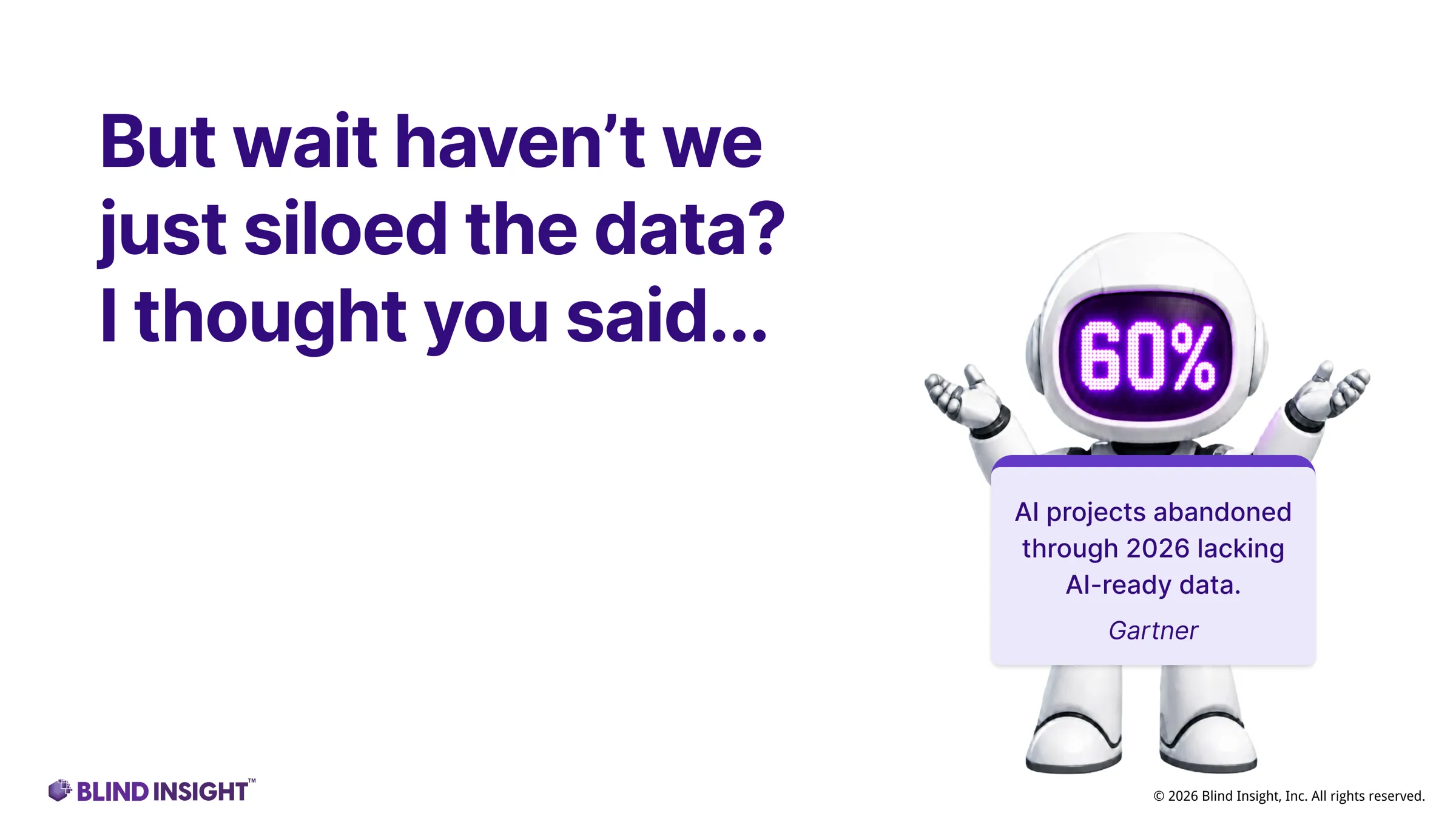
Segregation has a second bill. Gartner expects
60% of AI projects to be abandoned through 2026
for lack of AI-ready data — and data locked in a protected processing environment is, by design, not AI-ready.
Encryption-in-use doesn’t have to mean “rip and replace”
Modern privacy-enhancing technologies can allow organizations to perform useful operations while keeping sensitive information protected, at a fraction of what many organizations once thought it cost. That’s not a claim to take on faith — see what we won’t oversell about where encryption-in-use is still catching up, phrase search speed among them.
Organizations don’t have to choose between useful data or protected data. They can increasingly architect for useful and protected data.
Where Blind Insight fits
This is what “possible now” looks like in one picture. Data is encrypted by the Blind Proxy before it lands in the warehouse you already run, it stays encrypted while it is queried, aggregated, matched, and trained on, and the six workloads along the bottom are the financial-services jobs running on it today.
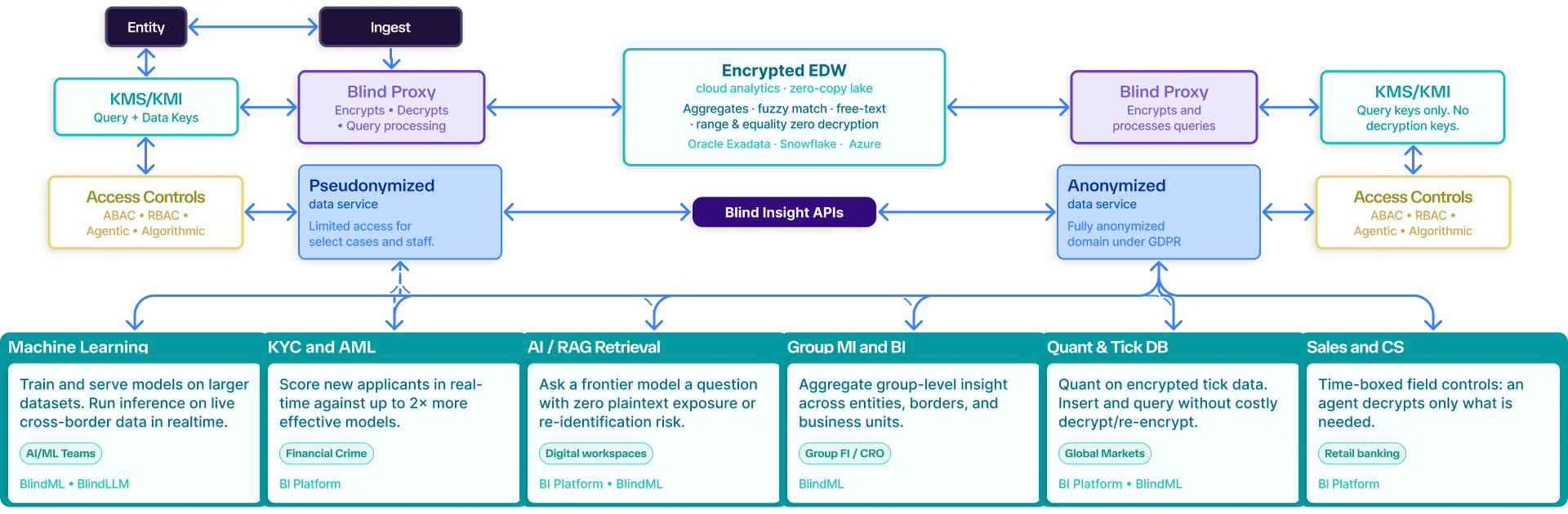
Reference architecture for an encrypted enterprise data warehouse: one encrypted source, two GDPR postures (pseudonymized and anonymized), six financial-services workloads.
How to read it:
- Blind Proxy — encrypts in-region on the way in and processes queries on the way out; the application layer never holds plaintext it wasn’t granted. Platform overview.
- Encrypted EDW — the warehouse you already run, holding ciphertext. Aggregates, fuzzy match, free-text, range, and equality all execute with zero decryption. How that compares to FHE, enclaves, and tokenization.
- KMS/KMI and access controls — the analytics side holds query keys only. Decryption keys are placed on a user’s or agent’s keyring only for the fields their grant permits, under ABAC, RBAC, agentic, or algorithmic policy. How grants work for agents.
- Pseudonymized and anonymized data services — two GDPR postures from one encrypted source: limited access for select cases and staff, or a fully anonymized domain. The configurations are documented in the DORA / GDPR / HIPAA compliance playbook.
- The use-case row — model training and inference on BlindML, retrieval and agent workflows on BlindLLM, and KYC/AML scoring, group MI, quant on encrypted tick data, and time-boxed field controls on the platform. Financial services overview.
Protect data in use
Blind Insight enables organizations to work with sensitive data while maintaining encryption rather than routinely exposing plaintext to the application and database layer. The same protection extends to AI agents and LLM inference sitting on top of that data — see how encrypted inference and agent guardrails work.
Reduce compensating-control complexity
Instead of building an ever-growing collection of controls around plaintext processing environments, organizations can move toward a security architecture where the data itself remains protected.
Build for the regulatory future
DORA isn’t just another box to check. It’s a catalyst to build an architecture stronger than the minimum compliance most organizations settle for. For the control-by-control mapping — including where counsel still has to sign off — see the compliance playbook Cameron wrote for GDPR, HIPAA, and DORA.
DORA compliance across the data lifecycle
| Data state | DORA concern | Traditional approach | Privacy-preserving approach |
|---|---|---|---|
| At rest | Confidentiality, integrity | Encryption at rest | Encryption |
| In transit | Confidentiality, integrity | TLS / network encryption | Encryption |
| In use | Confidentiality, integrity, authenticity, availability | Plaintext processing + compensating controls | Encryption-in-use / privacy-enhancing technology |
| Keys | Key lifecycle and security | Centralized key management | Cryptographic key controls |
| Future threats | Resilience | Periodic upgrades | Architecture designed for evolving cryptography |
Blind Insight can become one layer of a broader DORA encryption and cryptographic-controls strategy. For how this maps to model training and inference specifically, see the full DORA Art. 9(2) and GDPR walkthrough for AI workloads.
The business case: spend once vs. keep paying
The traditional approach: DORA requirement → compensating controls → audit → remediation → new regulation → additional controls → repeat.
The privacy-preserving approach: DORA requirement → stronger data architecture → reusable security control → adapt as requirements evolve.
Nowhere is the difference sharper than expansion. Every new territory arrives with its own supervisor, its own residency rule, and — on the fallback — its own protected processing environment, with the whole control list above rebuilt for one more jurisdiction. Encryption-in-use inverts that: one encrypted source, encrypted in-region, with a key and grant policy per jurisdiction — a fraud analyst in Germany who decrypts nothing, an analyst in the US who decrypts one risk field — so a new market is a configuration, not a build. That return is not deferred. It lands on the first market you enter after the architecture is in place, and again on every one after it.
The question isn’t simply “What is the cheapest way to comply with DORA today?” It’s “What architecture gives us the lowest total cost of compliance over the next five, ten, or fifteen years?”
Future-proofing financial data
DORA is one piece of a much larger shift toward treating data security as a lifecycle problem rather than a storage problem. Institutions increasingly need architecture that holds up across data minimization, cross-border transfer, third-party processing, AI workloads, and attacks and cryptographic threats that are still evolving.
DORA’s own RTS explicitly says financial entities should remain abreast of developments in cryptanalysis and adapt cryptographic technology as needed. (EUR-Lex)
The bottom line
DORA does not make encryption-in-use universally mandatory. It recognizes that it may not always be feasible and provides a risk-based alternative.
But “permitted” doesn’t mean “optimal.”
For financial institutions, the real opportunity is to stop optimizing for today’s minimum and start building the architecture that protects sensitive data for good.
Encryption-in-use can turn that challenge into an opportunity: stronger security, fewer compensating controls, and an architecture better positioned for whatever comes next.
Blind Insight gives financial institutions a practical path there now — sensitive data stays protected and useful, without trading security for cost.
DORA didn’t invent the choice between compliant and defensible — it just made it visible. The RTS fallback keeps you inside Article 9(2) today, but only for as long as encryption in use is “not possible” for your workload — and that is no longer a claim that ages well. It also doesn’t stop the compensating-control bill from arriving the next time the standard moves. Encryption-in-use is the version that doesn’t need re-litigating in three years — see the compliance FAQ for how this maps against GDPR and HIPAA too.
From demo to production in weeks. Book a demo and we’ll walk the DORA mapping against your schema, then start in the sandbox — nothing to deploy, synthetic data in your shape, live in 72 hours. Or try it on your own schema today.
From demo to production in weeks.
Start in the sandbox: nothing to deploy, your schema on synthetic data, live in 72 hours. Validate against live pipelines, then ship secure AI, ML, and analytics across your stack.
Keep reading

AI Compliance Under DORA and GDPR: A Practical Guide
Financial institutions must satisfy DORA Art. 9(2) and GDPR Art. 32 while running AI on sensitive data. Learn what compliant architectures look like.
Turn New Privacy Rules Into Your Competitive Advantage: The EDPB Pseudonymization Breakthrough
What's in a name? How the EDPB's recent guidance on pseudonymization pave the way for better, smarter, faster data sharing.
Practical Implications of the New EDPB Pseudonymization Guidelines
Learn how the proposed EDPB guidelines may impact your organization in part two of this three-part series.